
How to Encourage Google Reviews Without Sounding Pushy

A Guide for Independent Retailers

You know that your reputation is everything. In the digital age, that reputation is often boiled down to a single number: your Google star rating. It is the modern-day version of a "Recommended" sign in the window, but with far more reach. However, there is a common hurdle every shop, café, and salon owner faces:
How to ask for a review without it sounding awkward.
You want the feedback, and you know your customers are happy, but you don't want to come across as desperate or intrusive. The good news? You can encourage Google reviews in a way that feels like a natural extension of your excellent customer service.
In this guide, we will explore how to turn satisfied visitors into vocal advocates by mastering the art of the subtle ask.
Why Google Reviews Matter More Than Ever
Before we dive into the how, let's quickly touch on the why. Google reviews are not just about vanity; they are a critical engine for growth.
Local SEO Dominance: Google’s algorithm prioritises businesses with a high volume of recent, positive reviews. If you want to appear in the Map Pack when someone searches for "best coffee near me", you need a steady stream of feedback.
Social Proof: Research suggests that roughly 93% of consumers read online reviews before making a purchase. In a world of "app fatigue" and fragmented marketing, a simple 5-star review provides the clarity consumers crave.
The Feedback Loop: Reviews provide honest insights into what you are doing right and where you might need to tweak your operations.
1. The Psychology of the Natural Ask
The reason asking for reviews feels pushy is usually poor timing or a lack of context. If you ask for a review before the customer has even finished their meal or seen the results of their hair appointment, it feels like a transaction rather than a relationship.
To encourage Google reviews effectively, you must identify the "Peak Moment". This is the point in the customer journey where their satisfaction is at its highest.
For a Café: It’s that first sip of a perfectly poured latte.
For a Salon: It’s the moment the client looks in the mirror and sees their new style.
For a Gym: It’s the post-workout endorphin rush.
When you ask at the peak moment, you aren't begging for a favour; you are simply asking them to share their positive experience with the community.
2. Low-Friction Methods to Encourage Google Reviews
One of the biggest barriers to getting reviews is friction. If a customer has to search for your business, click three different buttons, and then log in, they simply won't do it. Consumers today are overwhelmed and strongly reluctant to take extra steps that feel like work.
The Power of the QR Code
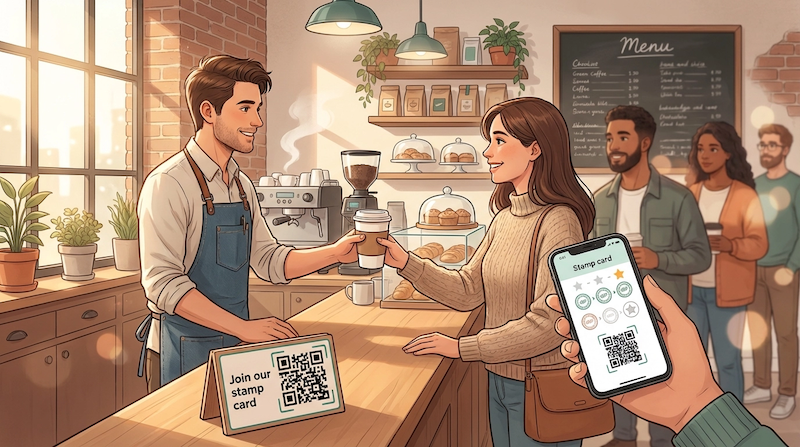
Just as we use QR codes to make loyalty programs frictionless and easy, you can use them to bridge the gap between the physical and digital world.
Instead of saying, "Find us on Google," place a small, tastefully designed card at the point of sale or on tables with a QR code that links directly to your Google review submission page.
Pro Tip: Don't just link to your Google Maps profile. Use a Review Link (generated in your Google Business Profile manager) that opens the 5-star rating window automatically.
Strategic Signage
Your signage should be helpful, not demanding. Instead of "Leave us a review," try phrasing that focuses on the community:
"Love your local? Help others find us by sharing your experience."
"Small businesses run on feedback. Let us know how we did!"
"Scan here to help our team grow."
3. Training Your Team for the Verbal Prompt
Your staff are your greatest assets. They are the ones building the rapport that leads to a review. However, many staff members feel just as awkward asking as you do.
The secret is to tie the request to a compliment. If a customer says, "That was the best steak I've had in months," that is the green light.
The Script:
"I’m so glad you enjoyed it! Honestly, it makes our chef's day to hear that. If you have a spare thirty seconds, would you mind sharing that on Google? It really helps a small business like ours get noticed."
By framing the request as a way to support the "chef" or the "team," you move the focus away from a corporate metric and toward a human connection.
4. Dealing with the "Fear of the 1-Star"
Many owners hesitate to encourage Google reviews for fear of the occasional negative comment. Here is the reality: a profile with 100% 5-star reviews often looks suspicious to savvy consumers. A few 4-star, or even 3-star, reviews make you look real.
The key is how you respond. A professional, empathetic response to a negative review often impresses potential customers more than the positive reviews themselves. It shows you are a business that cares about fixing problems.
ALWAYS respond to negative reviews.
5. The Ultimate Strategy: Leverage Your Loyalists
The most effective way to get high-quality reviews is to target the people who already love you. This is where your loyalty strategy and your reputation management collide.
At meed, we believe that the "broken" loyalty industry has made it too hard for businesses and customers to connect. Most loyalty programmes are fragmented and require too many apps, leading to dormant accounts and app fatigue.
When you simplify the loyalty experience, removing the need for an app and making enrolment as easy as a 60-second QR scan, you create a membership base that is genuinely engaged with your brand.
Why Loyalists are Your Best Reviewers:
They have "PID" (Personally Identifiable Data): While meed protects consumer privacy by sharing aggregated behavioural data with businesses, the relationship you build through the platform is very real.
They are Advocates: Our goal at meed is to elevate paid members into advocates. These are the people who won't just leave you a review; they will tell their friends, share your social posts, and become a part of your business's success story.
Higher Intent: A customer who has scanned your meed QR code to earn their 5th stamp is already invested in your success. Asking them for a review isn't pushy; it's asking a friend for a quick favour.
Conclusion: Building a Reputation that Lasts
Encouraging Google reviews doesn't have to be a chore or a source of anxiety. By focusing on the peak moments of your customer's experience, reducing the friction with QR codes, and training your team to ask with heart, you can build a 5-star reputation organically.
Remember, the best reviews come from the most loyal customers. If you can solve the onboarding issue and keep your customers engaged without the friction of traditional apps, you are halfway there.
If you want to turn your customers into members, create your digital stamp card for free on meed today. It's free until 50 members, so you know it is working for you.


Comments