
What Your Staff Needs to Know Before Your Loyalty Program Goes Live

Updated: Jul 28
A loyalty program fails at the counter before it ever fails with customers. The technology, the rewards, the branding - none of it matters if the person taking orders doesn't know how to explain it in ten seconds or less. Staff readiness is the single most overlooked launch variable for independent businesses, and getting it wrong wastes the entire setup effort. This article covers what your team needs to understand, what they need to be able to say, and where most businesses get it wrong.
TL;DR
Staff who can't explain your loyalty program confidently will kill sign-up rates before they start
Your team needs a one-sentence pitch, not a full feature walkthrough
Enrollment friction happens at the counter, not in the technology
Role clarity matters - who enrolls, who redeems, who handles questions
The first two weeks of a launch determine long-term program health
About the Author: meed works with independent businesses across cafes, salons, gyms, and retail to launch digital loyalty programs - often within a single day. The patterns below come from watching what separates programs that gain traction from programs that quietly die.
Why Does Staff Preparation Decide Whether a Loyalty Program Survives?
Staff are the distribution channel. Every loyalty sign-up requires a human moment at the point of sale. If your team is uncertain, distracted, or simply undertrained, customers don't enroll. It's that direct.
The gap isn't usually enthusiasm. Most staff are willing. The gap is that owners assume the program explains itself. It doesn't. A customer needs to hear something simple, decide quickly, and act in the same transaction. That window is about fifteen seconds.
What breaks it:
Staff giving a vague answer when asked "how does it work?"
No one knowing where the QR code is or how to pull it up
Inconsistent explanations across different team members
Redemption moments that stall because nobody knows the process
What Is the Minimum Staff Need to Know Before Day One?
Three things. Not ten. Not a full manual.
The one-line pitch. What the customer gets and how to get it. Example: "Scan your receipt, collect stamps, get a free coffee." One sentence. Practiced out loud until it sounds natural.
How enrollment happens. Where is the QR code? What does the customer do with it? Does it go to their phone's wallet automatically? Who confirms it worked?
How rewards get redeemed. What does the customer show? What does the staff member do? Is there anything to press on a device, or does the customer handle it entirely?
Everything else - analytics, program settings, birthday coupons - that's for the owner. Front-line staff need the three points above, nothing more.
How Should You Brief Your Team Without Slowing Down a Busy Shift?
A pre-shift briefing. Five minutes. Not a training session, not a slide deck.
Run them through a live mock transaction. One staff member plays the customer. Walk from greeting to enrollment to a hypothetical redemption. The goal is that nobody encounters the program for the first time in front of an actual customer.
Print a single reference card for the counter. It should have:
The QR code or enrollment link
The one-line pitch
What a reward redemption looks like
Who to ask if something goes wrong
That card does more work than any training manual.
What Role Should Each Staff Member Play?
Role ambiguity is where programs stall. If anyone can enroll but nobody is responsible for it, nobody does it consistently.
Role | Responsibility | What They Need to Know |
Counter / front-of-house staff | Mention the program at checkout, show the QR code | The one-line pitch, where to find the QR code |
All customer-facing staff | Handle enrollment confirmations and basic questions | What the customer's phone should show after joining |
Shift manager or owner | Handle redemptions, edge cases, and complaints | Full program structure, reward tiers, how to check member status |
Keep it this simple. The moment roles blur, consistency drops.
What Are the Most Common Staff Mistakes in the First Two Weeks?
The launch window matters more than any other period. Most programs either gain early momentum or quietly fade. The causes of failure are predictable.
Not mentioning it at all. Staff assume customers will notice on their own. Most won't. The program needs to be offered, every transaction, for at least the first two weeks.
Over-explaining. A three-minute explanation at a busy counter loses the customer and the queue behind them. Short and done beats thorough and awkward.
Inconsistent redemptions. One staff member honors a reward. Another hesitates and asks the owner. The customer notices. Define the process before launch, not during it.
Forgetting to ask at the end of a transaction. Enrollment works best as a natural close: "We've got a loyalty program - want to join? Just scan this." Two seconds. Tacked onto the moment naturally.
How Do You Keep Staff Engaged With the Program After Launch?
Staff promote what they understand and what feels relevant to them.
Share simple numbers. Not dashboards, not percentages - just the raw count. "We got 40 new loyalty members this week." That lands. It confirms the effort is working and gives staff a sense of contribution.
Acknowledge it in team conversations. Not a formal review, just a mention. "The QR code sign-ups are up, good work mentioning it." Specificity matters more than praise.
Programs that give staff no feedback after launch get treated like admin tasks. Programs that share simple results get treated like something worth doing.
Does the Type of Loyalty Technology Change What Staff Need to Know?
Yes. And it's worth being direct about this.
Some loyalty systems require staff to interact with a POS, enter codes, or manage a separate device. Each of those steps is a failure point. If a staff member has to do something complex mid-transaction, they'll avoid offering the program during rush hours - which are exactly the hours it matters most.
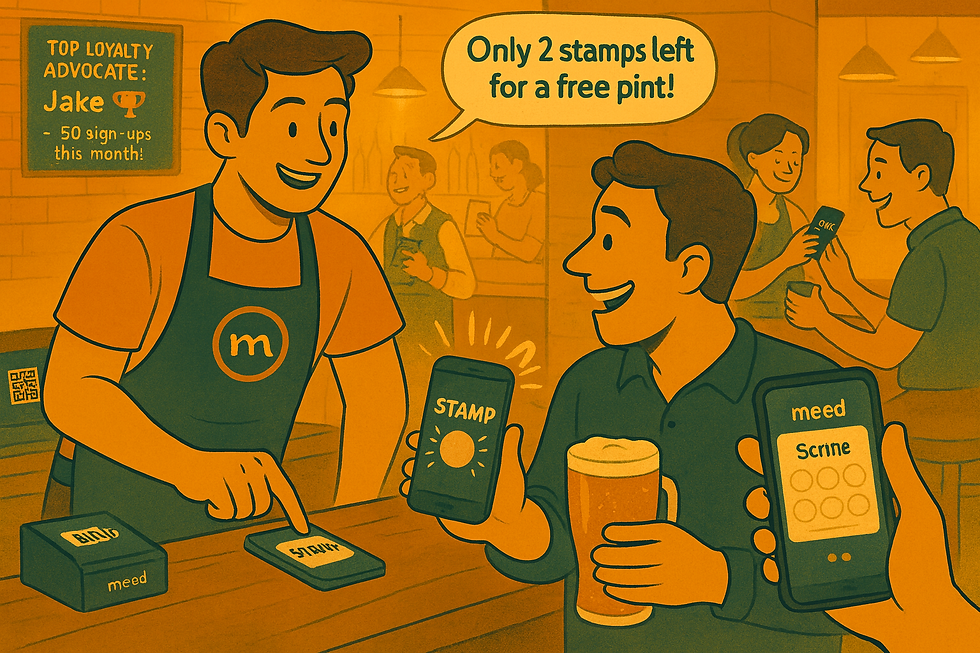
The simplest staff experience is one where the customer handles enrollment themselves. With meed, customers join by scanning a QR code or tapping an NFC point, and the loyalty card goes straight to their Apple or Google Wallet. Staff don't manage an app, don't enter anything into a system, and don't need to troubleshoot a download. The enrollment action shifts to the customer, which removes the counter friction entirely.
Rewards redeem directly from the customer's phone. The staff member sees it, confirms it. That's the full interaction. Under thirty seconds, no device required from the business side.
Frequently Asked Questions
How much time should I spend training staff before launch?
One focused five-minute briefing covers the essentials. Anything longer and the detail gets lost. Keep a reference card at the counter for the first two weeks.
What if a customer asks a question my staff can't answer?
Build that into the briefing. "I'll grab the owner for that one" is a perfectly fine answer. What's not fine is staff making up an answer on the spot. Define the escalation path before day one.
Should part-time or casual staff be briefed the same way?
Yes, and more urgently than full-time staff. Casual workers fill your busiest shifts. If they don't know the program, your peak hours become a loyalty dead zone.
What if staff forget to mention the program during busy periods?
Expect it. Counter prompts help - a small sign near the QR code that the customer can see themselves reduces dependence on staff memory entirely.
How do staff handle a reward redemption if they're unsure it's valid?
Honor it, then check. A declined reward that was valid destroys more goodwill than an honored reward that wasn't. Set that as the default policy and review edge cases offline.
Does the loyalty platform itself need staff training?
Depends on the platform. If customers self-enroll and self-redeem via their phone wallet, staff training is minimal. If the platform requires staff to operate a device or enter codes, training becomes critical and ongoing.
How do I know if staff are actually promoting the program?
Watch sign-up numbers week over week. A flat or declining sign-up rate after launch, with no external cause, usually points to staff not mentioning it. Address it directly in a brief team conversation.
About meed
meed is a digital loyalty platform built for independent and small businesses. Customers join via QR code or NFC tap and carry their loyalty card in Apple or Google Wallet - nothing to download, nothing for staff to manage. meed's AI receipt scanning means there's no POS integration required, making setup fast for any business regardless of their existing technology. For businesses that want a loyalty program that works from day one without adding complexity to their counter, meed is the place to start.
Ready to launch a loyalty program your staff can explain in one sentence?
See how meed works and get started at meedloyalty.com.


Comments