
$59 a Month Is What Most Small Businesses Spend on Coffee for the Counter

Updated: Jul 28
Most independent businesses are already spending what a full loyalty program costs. Not on marketing. On counter expenses, coffee pods, machine maintenance, the small stuff that never gets questioned. The math doesn't require a meeting. It requires a decision.
TL;DR
$59/month is the full cost of meed's Pro loyalty plan, a figure comparable to what many small businesses spend on incidental counter expenses [2].
Most small businesses operate without any formal loyalty system, despite customer retention being significantly cheaper than acquisition.
A Google Wallet loyalty card or Apple Wallet card requires no app download, removing the biggest barrier to customer adoption.
Members visit more often and spend more per visit than non-members. That gap compounds across a full year of trading.
The best customer loyalty software for independent businesses is the one that runs without a tech team, POS integration, or a six-month setup timeline.
About the Author:
meed is a digital loyalty platform built exclusively for independent and small businesses. With clients across cafes, salons, gyms, and retail in markets spanning Asia, Europe, and beyond, meed's perspective on loyalty economics comes from the businesses running these programs day to day, not from theory.
$59 a Month Buys Two Very Different Things
Worth being precise about what $59 buys in either direction.
On the counter expenses side, a typical small business running a counter for staff and walk-in clients spends a comparable amount monthly on beans, pods, and machine maintenance. That cost never gets scrutinized because it feels small.
On the loyalty side, $59/month is the price of meed's Pro plan: unlimited members, branded loyalty cards stored in Apple Wallet and Google Wallet, AI-powered receipt scanning, NFC check-ins, analytics, digital coupons, birthday rewards, and multi-location support for the first two sites. No POS integration required. Under five minutes to configure.
One of those expenditures is invisible. The other one compounds.
Most Small Businesses Have No Loyalty Program
The common answer is cost. The real answer is friction.
Most loyalty tools were built for chains. They assume a tech team, a POS provider partnership, and a customer base willing to download another app. Independent businesses have none of those things. They skip loyalty entirely, hand out paper punch cards, or sign up for something that never gets configured.
Most small businesses pour their marketing budget into attracting new people while doing nothing to hold onto the ones already walking in. Retention is cheaper. The tools just weren't built for them.
The Real Customer Loyalty Program Benefits for Independent Businesses
A coffee shop in Santiago went from guessing which customers were regulars to knowing exactly who came back and when. That shift shows up in how you run promotions, staffing, and stock decisions. The benefits behind it are consistent across independent businesses:
Repeat visit frequency increases. Members who are enrolled in a program tend to return more regularly than those who aren't. The card in their wallet is a passive reminder that they have something to come back for.
Average spend per visit rises. A customer who is three stamps away from a free coffee will often buy something extra to get there faster. That behavior is predictable and consistent.
You know who your regulars are. Not a feeling. Actual data. Names, visit frequency, redemption history.
Small retention improvements have large revenue effects. Even a modest improvement in how many customers return for a second or third visit compounds across a full year of trading.
None of this requires a marketing degree. It requires a system that captures the data in the first place.
A Coffee Shop Loyalty Card Doesn't Need to Be an App
This is where most business owners get it wrong, including the ones shopping for a coffee shop loyalty app.
The word "app" implies a download. A download implies friction. Friction means customers don't bother. You've seen it: the QR code on the counter that leads to an App Store page, and the customer who smiles politely and doesn't touch their phone.
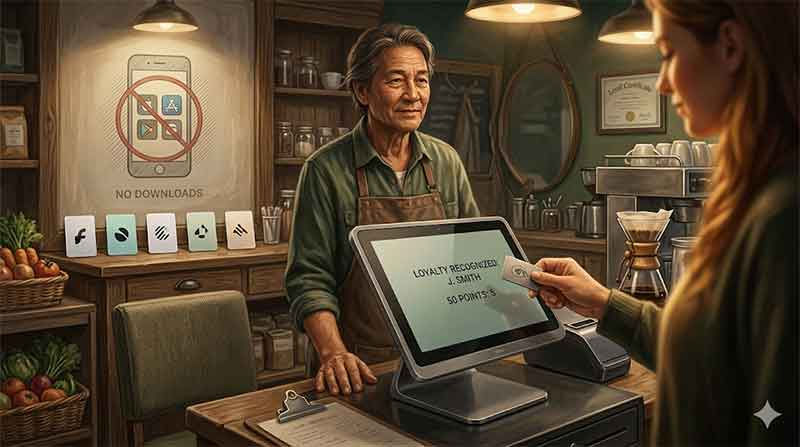
A Google Wallet loyalty card or an Apple Wallet loyalty card works differently. The card is added to a wallet the customer already has on their phone. There's nothing to download. Nothing to create an account for. One tap or one scan and they're enrolled.
That single difference changes adoption rates. A loyalty program that customers don't join is just an expense. One they use is a retention asset.
Comparing the Best Customer Loyalty Software Without Wasting Time
Most comparison frameworks ask the wrong questions. Here's a more useful one for independent businesses:
Question | Why It Matters |
Does the customer need to download anything? | App fatigue is real. Wallet-native cards have meaningfully higher adoption. |
Does setup require POS integration? | Most independent businesses can't or won't change their POS for a loyalty tool. |
How long does setup actually take? | If it takes a week of configuration, it usually doesn't get done at all. |
Can you run it without a tech team? | Owners are running businesses, not IT departments. |
What does it cost at full functionality? | Free tiers that cap at 50 members or lock key features aren't free in practice. |
Does it give you actual data? | Knowing who your members are and when they visit is the whole point. |
The best customer loyalty software for an independent business scores well across all six. A tool that nails the first two but fails the rest is still a liability.
What a Realistic Small Business Marketing Budget Should Allocate to Retention
Running costs for a coffee shop sit between $40,000 and $45,000 per month in 2026, with rent, labor, and cost of goods dominating [1]. Opening one costs between $80,000 and $300,000 before the first cup is served [3]. Against those numbers, a $59/month loyalty program is rounding error territory.
And yet, most small business marketing budget conversations focus entirely on acquisition: ads, flyers, social posts, influencer mentions. Spend categories with no compounding return. Stop paying, they stop producing.
Retention works differently. Every enrolled member is an asset that exists whether or not you're actively spending that month. The program runs. The stamps accumulate. The wallet notifications fire when a member walks nearby. It keeps running while you're focused on the floor.
Spend something on retention before increasing acquisition. Pouring more into acquisition without it is filling a leaking bucket.
Frequently Asked Questions
Q: What is the customer retention cost compared to new customer acquisition?
Acquiring a new customer consistently costs more than retaining an existing one, with some estimates putting it at five times more expensive. The precise multiple varies by industry and channel, but the direction is always the same. Keeping customers is cheaper than finding new ones.
Q: How does a Google Wallet loyalty card work for a small business?
A business creates a branded loyalty card through a platform like meed. Customers add it to Google Wallet via a QR code, link, or NFC tap. No app download required. The card tracks stamps or points, sends location-triggered notifications, and lets customers redeem rewards directly from their phone.
Q: What are the customer loyalty program benefits for independent cafes specifically?
For cafes, the primary benefits are repeat visit frequency, higher average transaction values from customers working toward rewards, and visibility into who your regulars actually are. Paper punch cards give you none of the third benefit.
Q: Do customers actually use wallet-based loyalty cards?
Adoption is higher than app-based programs because there's nothing to install. Customers already have Apple Wallet or Google Wallet. Adding a loyalty card takes seconds. The lower the friction, the higher the enrollment rate.
Q: Is $59 a month reasonable for a loyalty program if you're a very small business?
meed offers a free plan that supports up to 50 members with all features included. That's a meaningful starting point for micro businesses. The Pro plan at $59/month, or $590/year, makes sense once you've confirmed the program is generating repeat visits. You can start free and upgrade when the math justifies it.
Q: Does a coffee shop loyalty app need POS integration to work?
Not with AI receipt scanning. meed's Scan by meed feature reads receipts directly, so customers scan their receipt to earn stamps without any POS connection required. That removes the main technical barrier for independent businesses.
Q: What makes the best customer loyalty software for a business with no tech team?
Fast setup, no integration dependencies, wallet-native customer experience, and a dashboard simple enough to manage during a busy week. The best platform for an independent business is the one that runs without requiring ongoing technical maintenance.
About meed
meed is a digital loyalty platform built for independent and small businesses, nothing else. Loyalty cards sit natively in Apple Wallet and Google Wallet, with no app download required for customers. Businesses can set up a fully branded program in under five minutes using NFC check-ins, AI receipt scanning, or QR codes, with no POS integration needed. meed serves cafes, salons, gyms, retailers, and event organizers across international markets, with a free plan for businesses just starting out and a Pro plan at US$59/month for those ready to scale.
Your regulars are already choosing you. meed makes sure you know who they are.
References
Coffee Shop Running Costs: $42k/Month Budget (2026) (financialmodelslab.com)
12 Best Coffee Subscriptions, Reviewed & Reordered (2026) | Bon Appétit (www.bonappetit.com)
Inside the Numbers: What It Really Costs to Open a Coffee Shop in 2026 | My Coffee Explorer (mycoffeeexplorer.com)


Comments