
What Independent Restaurants in the UK Actually Lose Each Month Without a Loyalty Program

Updated: Jul 28
Independent restaurants in the UK are losing measurable revenue every month they operate without a loyalty program. Not because loyalty is a luxury feature, but because repeat customers spend more, visit more often, and cost nothing to acquire once they are in the door. Without a structured way to retain them, those customers drift. They do not announce their departure. They just stop coming back, and you have no mechanism to notice or respond.
TL;DR
UK independent restaurants face rising costs in 2026 and cannot afford to lose regulars silently.
The real cost of no loyalty program is not a missed stamp card. It is the compounding loss of repeat spend from customers who had no reason to stay loyal.
Loyalty members typically spend significantly more per visit and visit more frequently than non-members.
A Google Wallet loyalty card and Apple Wallet equivalent remove every barrier that kills loyalty program participation: no app, no device, nothing extra for the customer to carry.
meed's free plan gives independent restaurants a working loyalty program with core features at no cost. Pro adds custom notifications and advanced analytics.
About the Author: meed is a digital loyalty platform built specifically for independent and small businesses. With wallet-native loyalty programs running across restaurants, cafes, bars, and retail businesses internationally, meed's perspective on customer retention is grounded in what works at the operator level, not in theory.
Why Does 2026 Feel Different for UK Restaurant Owners?
The structural pressures on independent restaurants right now are not cyclical. They are not "things will settle down." The Autumn Budget 2024 pushed employer National Insurance contributions higher and lowered the threshold at which they kick in, with those changes taking effect in April 2025, meaning labour costs in 2026 are meaningfully higher than they were twelve months ago [5][6]. Energy costs have not fully retreated. Food input costs remain elevated [3]. And the customer who used to come in twice a week is now thinking harder about discretionary spend [2][7].
The Good Food Guide's recognition of independent local restaurants in 2026 reflects genuine appetite for them [1]. Diners are not abandoning independents. But the evidence also shows they are being more deliberate about where they spend [2]. That deliberateness is a signal. The restaurants they keep returning to are the ones that have given them a reason to.
Against that backdrop, running with no retention mechanism is not a neutral position. It is an active cost.
What Does a Restaurant Actually Lose Without Loyalty?
The loss is not abstract. It maps to three specific behaviours:
Visit frequency drops. A customer with no loyalty incentive has no structural pull back to your venue. They liked their last visit. They will probably come back. But "probably" and "with a reason to" produce very different monthly cover counts.
Spend per visit stays flat or declines. Loyalty members typically spend more per transaction than non-members. The mechanism is simple: members are more engaged, more likely to try new menu items, and more likely to add on. Without that engagement, you are serving the transactional version of your customer.
You lose the data entirely. When a regular stops coming in, you have no way to know if it is permanent or temporary. You cannot reach out. You cannot offer anything. The relationship ends in silence.
The National Restaurant Association's 2026 industry report notes that operators are increasingly focused on customer retention as a margin lever, not just a brand exercise [4]. That framing matters. Retention is a financial strategy, not a customer experience add-on.
Small retention improvements compound significantly. Even a modest increase in the number of customers who return for a second and third visit changes the monthly P&L in a way that new customer acquisition rarely does, because the cost of that retention is a fraction of what acquisition costs.
Why Do Most Independent Restaurants Not Have a Loyalty Program?
Three reasons come up consistently:
Setup complexity. Most loyalty tools assume you have a POS system, a tech team, or both. Independent operators often have neither.
Customer friction. Any program that requires an app download loses the majority of customers at that step. App fatigue is real. Customers already have phones full of apps they do not open.
Cost. Enterprise loyalty platforms are priced for chains. An independent restaurant with 200 regular customers cannot justify a monthly fee built for a 50-location franchise.
These are legitimate barriers. But they are 2019 barriers. The infrastructure has changed.
How Does Wallet-Native Loyalty Remove Those Barriers?
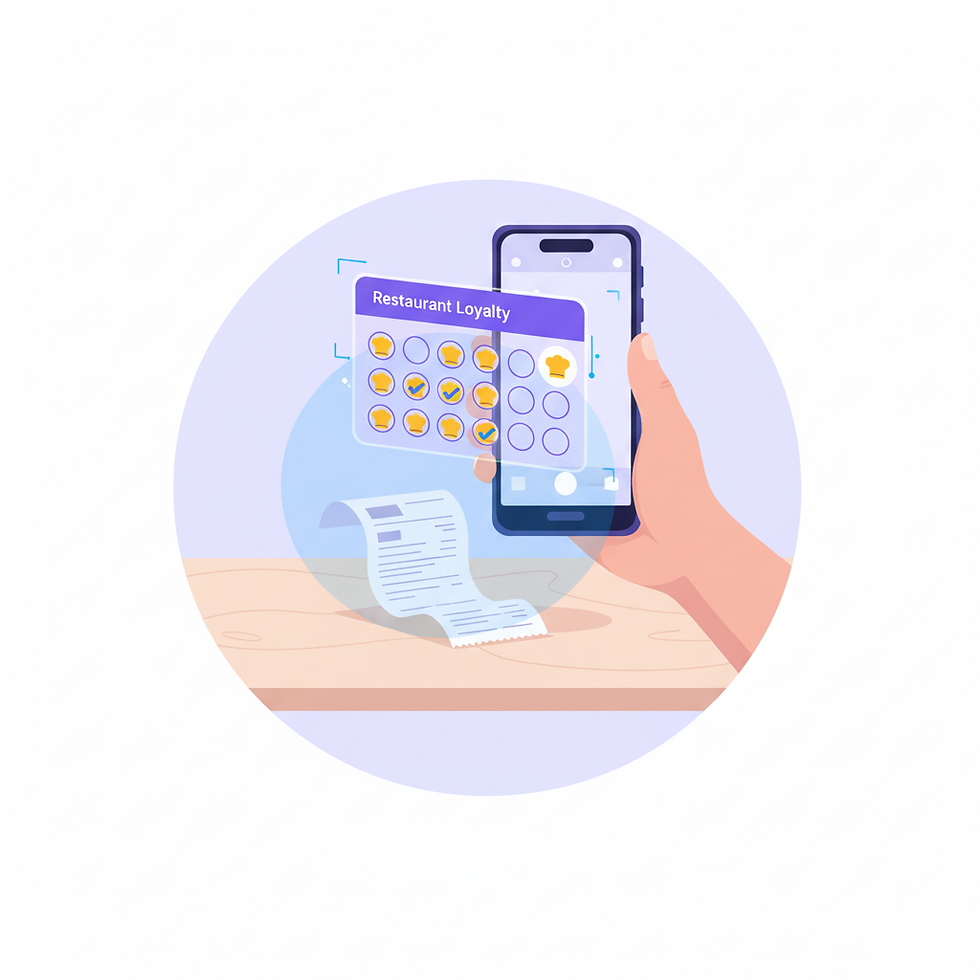
A Google Wallet loyalty card or Apple Wallet equivalent removes the app download problem entirely. The customer scans a QR code or taps an NFC point. The loyalty card saves directly to their phone's wallet. No account creation. No separate app. Nothing new to remember.
For the restaurant, setup does not require POS integration. meed's AI-powered receipt scanning reads the customer's receipt and awards points automatically. The business owner does not need a developer, a new terminal, or a lengthy onboarding process.
The table below shows the practical difference between legacy loyalty approaches and wallet-native loyalty:
Dimension | Legacy / Paper-Based | App-Based Digital Loyalty | Wallet-Native (e.g. meed) |
Customer setup | None (but card is easily lost) | App download required | QR scan or NFC tap, no download |
POS integration needed | No | Usually yes | No (AI receipt scan handles it) |
Data captured | None | Yes | Yes |
Location-triggered alerts | No | Varies | Yes, via wallet nearby notifications |
Custom messages to members | No | Varies | Yes, on meed Pro only |
Cost to start | Printing costs | Typically high | Free plan available (core features) |
What Does Re-Engagement Actually Look Like in Practice?
A customer enrolled in your loyalty program carries your card in their wallet. When they walk near your restaurant, wallet-based nearby notifications can surface your brand at exactly the right moment. That is available on both meed's free and Pro plans.
If you want to go further and send a custom message to members who have not visited in 30 days, that is a Pro-plan feature. It is the kind of targeted re-engagement that used to require a full CRM stack. On meed Pro, it is a push message you write and send from the business portal.
The distinction matters. If your goal is simply to run a structured loyalty program and retain the customers who are already showing up, the free plan with core features covers that. If you want to actively intervene when regulars go quiet, you need Pro.
How Do Rising UK Costs Make This More Urgent?
With the National Insurance secondary threshold having dropped to £5,000 in April 2025 and remaining frozen there, and minimum wage rising again in April 2026 [5][6], the cost of serving each cover has increased. That makes the value of each returning customer higher, and the cost of losing them to drift or to a competitor more significant.
The maths is not complicated. If a loyal regular spends more per visit and visits more frequently than a one-time customer, losing that regular is not just the loss of one cover. It is the loss of the full expected future value of that relationship. Across a year, across your full base of regulars, that number is material.
UK restaurant and café prices have more than doubled since 2000 [7]. Customers are aware of what they are spending. The ones who keep coming back to a specific independent restaurant are making a considered choice. The restaurants that make that choice easier, and that reward it, are the ones building a defensible business in 2026.
Frequently Asked Questions
Does a loyalty program actually change customer behaviour, or just reward people who would have come back anyway?
Both groups exist. But loyalty programs shift the balance. Members who have a reward within reach visit more frequently and spend more per visit. The structural nudge of being close to a reward changes spending behaviour, even for customers who were already inclined to return.
What is a Google Wallet loyalty card and how does a restaurant use one?
A Google Wallet loyalty card is a digital loyalty card stored in the Google Wallet app on a customer's Android phone. For a restaurant, it means the customer carries your loyalty card without downloading a separate app. With meed, a customer scans a QR code or taps an NFC point, and the card saves directly to their Google Wallet. Apple Wallet works the same way for iPhone users.
What does meed's free plan actually include for a restaurant?
The free plan includes core loyalty features: digital stamp cards, QR code enrollment, Apple and Google Wallet integration, and nearby notifications. It does not include custom notifications (business-initiated push messages) or advanced analytics. Those are Pro features.
When should a restaurant upgrade to meed Pro?
When you want to send custom messages to specific member segments, such as customers who have not visited recently, or when you need campaign and member performance analytics to understand what is working.
Does meed require a POS system or tech setup?
No. meed's AI receipt scanning reads a customer's receipt and awards the loyalty credit automatically. There is no POS integration required, which is the reason independent restaurants with no dedicated tech infrastructure can set it up and run it.
How long does setup take?
Under five minutes. The business portal is designed for operators who do not have time to learn new software mid-service.
Can meed work for a restaurant with multiple locations?
Yes. meed supports multi-location loyalty management.
About meed
meed is a digital loyalty platform built for independent and small businesses that need retention tools without the complexity or cost of enterprise software. Loyalty programs run directly through Apple Wallet and Google Wallet, with no app download required for customers. meed uses AI receipt scanning and NFC check-in to make enrollment and reward collection frictionless at the point of service. The free plan gives the smallest operators a working loyalty program from day one, while meed Pro adds custom notifications and advanced analytics for businesses ready to act on their member data.
Your regulars are already there. The challenge is keeping them.
See how meed works for independent restaurants at meedloyalty.com.
References
Britain's Best Local Restaurants 2026 | The Good Food Guide (www.thegoodfoodguide.co.uk)
The Good Food Guide's list of best local restaurants proves diners are 'saying no to fine dining' | The Independent (www.the-independent.com)
Why Even Great Restaurants Are Closing In 2026 (www.forbes.com)
2026 State of the Restaurant Industry | National Restaurant Association (restaurant.org)
UK Budget 2025 and your Restaurant: Protect Margins in 2026 | Flipdish (www.flipdish.com)
How the UK Budget will impact your restaurant's P&L in 2026 | Nory - Nory (www.nory.ai)
UK Eating Out Review: 2026 (store.mintel.com)


Comments