
How to Get UK Coffee Shop Customers to Actually Use Your Loyalty Programme: Sign-Up, Reminders and Redemption

Most coffee shop loyalty programmes fail at three exact moments: the counter (nobody asked), the pocket (the customer forgot it exists), and the till (the reward felt too far away to bother chasing). Fix those three moments and you fix the programme. You don't need better rewards or a bigger discount. You need a sign-up that takes ten seconds, a reminder that shows up without an app, and a first reward that arrives fast enough to matter.
TL;DR
Wallet-based sign-up (Apple Wallet, Google Wallet) has no app download barrier, so conversion starts higher than app-based schemes.
Customers stop using loyalty cards for three specific reasons: forgetting to carry them, rewards that take too long to earn, and sign-up that asks too much upfront.
QR code loyalty cards and digital punch card apps only work if enrolment happens at the counter, not on a poster nobody reads.
Short first rewards drive higher redemption than big final rewards.
Why do most coffee shop loyalty programmes get ignored?
A loyalty programme that customers don't join isn't a marketing problem, it's a design problem. Three specific failure points account for nearly all of it: nobody asks at the counter, the customer forgets the programme exists between visits, and the first reward feels too distant to bother pursuing. Each has a distinct fix, and none of them involve redesigning your rewards structure from scratch.
Customers abandon programmes for clear mechanical reasons: rewards that take too long to earn, physical cards left behind, and sign-up processes that demand too much upfront. That's not a customer engagement issue. That's three mechanical problems with three mechanical solutions.
How do I get customers to sign up in the first place?
Sign-up fails when it asks for more effort than the coffee is worth. A regular buying a flat white doesn't want to download an app, create a password, and verify an email before they've finished paying.
The counter is where sign-up either happens or doesn't. Staff need a script, not a poster. "Want me to add a stamp to a loyalty card, takes ten seconds" said at the till converts far better than a QR code stuck near the till that nobody scans unprompted. Signage helps reinforce it, but signage alone doesn't ask the question. A person has to ask.
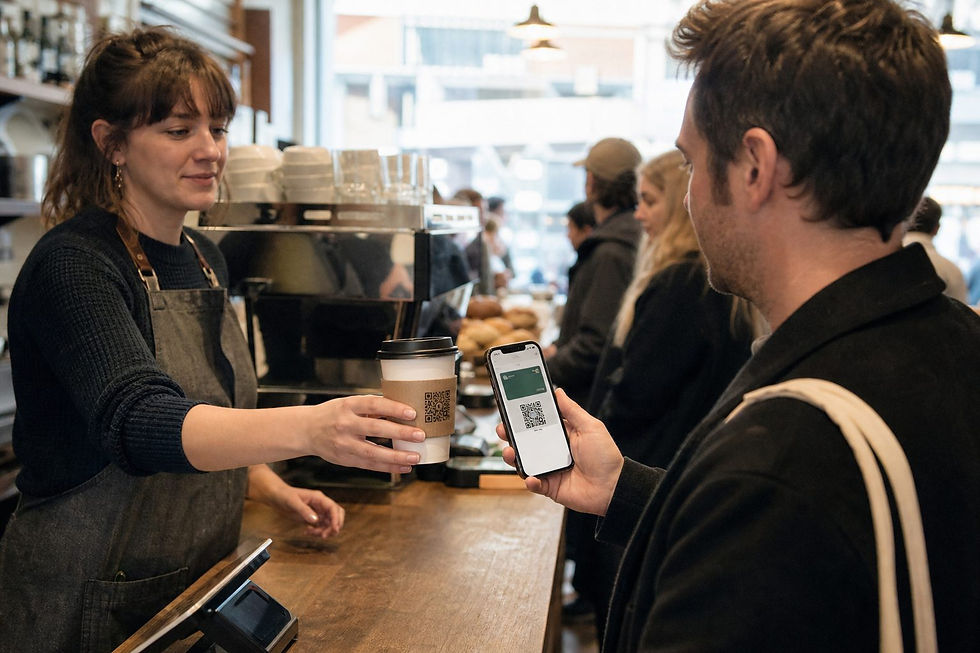
The mechanism matters here. An app-based loyalty programme asks heavy: find the app, install it, register an account. A QR code loyalty card that adds a pass straight to Apple Wallet or Google Wallet asks light: scan, tap add, done. No account, no password, no app taking up storage on a phone that already has too many apps on it.
This is the specific difference between a digital punch card app and a wallet-native pass. An app is another icon competing for space and attention. A wallet pass sits where the customer's boarding passes and payment cards already live, doing the same job a paper stamp card did, just harder to leave at home.
meed's enrolment supports QR code, NFC tap, or a shared link, all landing directly in Apple Wallet or Google Wallet with no app download involved. For a home-based or micro coffee business without a till system, meed also supports enrolment and reward tracking through AI-powered receipt scanning, so there's no POS integration needed to get a scheme running.
How do I stop customers forgetting the programme exists?
A customer who signed up and then forgot isn't a lost customer, they're a customer whose loyalty card is buried under seventeen other things. Paper stamp cards get left in coats, wallets and other bags. A digital card avoids that specific failure, but only if it resurfaces itself at the right moment.
This is what a reminder notification is for, and it works because of where the pass sits, not because the message is clever. A wallet pass on a lock screen when the customer walks near your shop is a physical nudge at the exact moment it's useful, not a marketing email read three days later when the moment's passed.
The technical detail matters if you're choosing between platforms. Apple Wallet allows up to 10 geofenced locations per pass with a 100-metre trigger radius, supports custom lock screen text, and has no daily notification limit. Google Wallet supports unlimited locations with a 150-metre radius, doesn't allow custom text on location alerts, and strictly limits notifications to four per day. Neither is better across the board, they're just built differently, and a loyalty platform needs to handle both without you thinking about it.
meed's nearby notifications are wallet-driven and location-triggered. On the free plan, location-based reminders trigger automatically when a customer nears your shop. If you want to send a custom message, say a one-off "free pastry this weekend only" push to everyone who's enrolled, that's a Pro-plan feature, because it's a business-initiated message rather than an automatic location trigger. If your goal is re-engaging customers who haven't visited in a few weeks with a specific message, that's the trigger to move to Pro, not something the free tier is built to do.
Why does the reward have to feel close, not big?
A reward ten purchases away doesn't motivate anyone on their first visit, it just reads as a long way off. The fix isn't a better reward. A closer one.
A first-visit stamp, given immediately, does more work than any discount buried at stamp number ten. It converts sign-up into a habit loop straight away: join, get a stamp, see progress, come back. Regulars are built on routine, and routine needs a hook early, not a payoff late [numarket.co].
The gap between low and high redemption usually comes down to reward distance and how clearly the reward is communicated, not the size of the discount. A shorter first reward, clearly signposted, moves a programme forward.
UK diners and coffee drinkers aren't short on loyalty schemes to choose from, they're loyal to a narrow set of brands they actually bother with [super44.ai]. Being one of the few worth the effort means making the first reward almost immediate, then lengthening the gap gradually once the habit is formed.
What does a working sign-up-to-redemption flow actually look like?
Building on the three fixes above, here's how they sit together in practice:
Failure point | Fix | Mechanism |
Nobody asked at the counter | A short counter script plus signage | Staff-led ask converts better than passive signage alone |
Customer forgot the programme exists | Wallet pass with nearby notification | Lock-screen reminder at the geofenced location, no app to open |
Reward felt too far away | A short first reward | Early payoff builds the habit loop before the longer-term reward |
Frequently Asked Questions
How do I get coffee shop customers to actually use my loyalty programme? Ask at the counter every time, make sign-up take under a minute using a QR code loyalty card straight into Apple Wallet or Google Wallet, and give a small reward on the first visit so the habit forms before the customer has time to forget the scheme exists.
How do I onboard cafe customers to a loyalty programme without making them download an app? Use a wallet-based sign-up method, QR code, NFC tap, or a shared link, that adds the loyalty card directly to Apple Wallet or Google Wallet. No account creation, no app store, no login. This removes the friction that app-based schemes create.
Why do customers stop using loyalty cards? Three reasons dominate: it takes too long to earn a reward, they forget to carry the physical card, and the sign-up process asked too much of them upfront. A digital wallet card fixes the second one directly and, combined with a shorter first reward, addresses the first.
How do I build a regular customer community around my independent coffee shop? Give regulars a reason to come back on a specific day or at a specific time, personalise the experience rather than treating loyalty as a generic discount scheme, and use notifications sparingly so they read as useful rather than as noise [sumup.com][rediem.co].
What's a realistic redemption rate to aim for? Shortening the distance to the first reward is the most direct lever available to move a programme forward.
Do I need a POS system to run a loyalty programme? No. meed's AI-powered receipt scanning reads receipts to award stamps and spend-based rewards without requiring POS integration, which matters for smaller or home-based coffee businesses running their first scheme.
What's the difference between nearby notifications and custom notifications? Nearby notifications are automatic, location-triggered alerts available on meed's free and Pro plans. Custom notifications are business-initiated push messages, available only on the Pro plan, and they're the right upgrade trigger if you want to message specific customers directly rather than relying on location triggers alone.
About meed
meed is built for independent businesses, including cafes and coffee shops, that need a loyalty scheme running in minutes rather than weeks. Customers enrol via QR code, NFC tap, or link, with the loyalty card landing directly in Apple Wallet or Google Wallet, no app download required. The free plan covers core features, digital cards, QR enrolment, wallet integration and nearby notifications, for up to 50 members, while the Pro plan adds custom notifications, advanced analytics, and multi-location management for growing or franchised coffee businesses.
If your loyalty programme is sitting unused behind the till, the fix usually isn't a bigger reward. A shorter sign-up, a reminder that reaches the customer without asking anything of them, and a first reward that arrives fast. Talk to meed about getting a wallet-based loyalty programme running in your coffee shop.


Comments