
Birthday Rewards and Digital Coupons for UK Coffee Shop Customers: What to Offer and How to Send It

A birthday reward for a UK coffee shop should cost the business very little, arrive automatically, and redeem in under ten seconds at the counter. That means collecting birth month only (never the full date), pairing it with one or two coupon types that reward behaviour you actually want more of, and delivering everything through a digital wallet pass rather than an app, email newsletter, or paper voucher someone forgets in a coat pocket.
TL;DR
Collect birth month only at sign-up, not full date of birth. Collecting only what you need triggers a reward and aligns with UK GDPR data minimisation.
Birthday rewards work best when they're a genuine gift, not a discount in disguise. Industry data shows birthday-triggered messages see transaction rates over 480 percent higher than standard promotional emails.
Three coupon types cover most independent coffee shops: a timed double-stamp window, a friends' coupon, and a new-menu taster coupon.
Coupons delivered to Apple Wallet or Google Wallet update automatically and don't need an app download, a POS integration, or a scanner at the till.
Redemption should work from a glance at the phone screen. If your staff need a manual to check if a coupon is valid, the coupon is too complicated.
About the Author: This article is written from meed's work building digital loyalty programmes for independent cafes and coffee shops across the UK and internationally, including businesses running their first loyalty scheme from a single till with no POS integration.
What customer data do you actually need to run a birthday reward?
You need a birth month. That's it. Not a birth date, not a birth year, not an ID upload. A birth month is enough to trigger a reward in the correct 30-day window, and it avoids the two problems full dates of birth create: age-related inference (which the UK GDPR treats as sensitive by proximity, especially when combined with other data) and the operational headache of storing full dates you don't need for anything else.
This is the data minimisation principle at work: collect only what's needed for the stated purpose, hold it for no longer than needed, and don't ask for more just because a signup form has a spare field. A coffee shop asking for a full date of birth to send one reward a year is collecting data it can't justify if a customer asks why it's stored. Asking for a month solves the same problem with less liability.
Practically, this means your loyalty sign-up form (QR code, link, or NFC tap) should have one optional field: birth month. Optional matters too. Making it compulsory to join the programme puts friction in front of people who'd otherwise sign up in five seconds.
What makes a good birthday reward for a coffee shop?
A good birthday reward feels like a gift, not a discount with a bow on it. That distinction matters more than most cafes think. Industry practice consistently shows that customers respond to genuine gifts, a free item with no spend attached, far better than they respond to "20% off your birthday order," because the second one still asks them to pay. A free hot drink, a free pastry, or a free size upgrade on their usual order reads as generosity. A discount reads as a sale.
The cost side is simpler than owners assume. A free coffee against the margin on a typical order is a small outlay for a reward that, according to industry data, drives birthday-specific engagement at over 480 percent above standard promotional messages. Compare that to the redemption rate on a generic discount coupon, which sits around 7 percent industry-wide. Birthday rewards are one of the highest-return, lowest-cost tools available to a small cafe, provided the reward itself doesn't feel like a marketing trick.
Keep it simple: one free drink, one free bake, or a fixed small credit. Don't stack conditions onto it ("free drink with any purchase over £5"). A condition on a birthday gift defeats the purpose.
Which digital coupon types actually work for an independent coffee shop?
Building on the birthday reward above, the harder question is what else you send throughout the year to keep the loyalty card relevant between visits. Three coupon types consistently perform well for small cafes because each targets a specific behaviour rather than just offering a blanket discount.
Coupon type | What it does | Behaviour it targets |
Timed double stamp | Stamps count double during a set window, e.g. weekday mornings before 10am | Fills quiet hours without discounting the drink itself |
Friends' coupon | A member shares a coupon code or link with a friend for a discount on their first visit | Turns existing regulars into a referral channel |
New-menu coupon | A small discount or free taster tied to a new drink or seasonal item | Gets regulars to try something new instead of ordering the same thing on autopilot |
None of these require complicated logic. A timed double-stamp coupon just needs a start and end condition. A friends' coupon needs a shareable link or code. A new-menu coupon needs a fixed expiry date tied to the launch. Under the UK CAP Code, any promotional coupon needs its significant conditions, start date, end date, eligibility, restrictions, displayed clearly and upfront, not buried in small print the customer finds after they've already queued.
How should birthday rewards and coupons actually be delivered?
A related but distinct question from what to offer is how it reaches the customer without extra effort on either side. The answer for most independent coffee shops is a digital wallet pass rather than an app, SMS, or email. Roughly 65 percent of UK adults are already registered for at least one mobile wallet service, with Apple Pay used by around 63 percent of consumers and Google Pay by around 37 percent. That's an existing habit, not a new one you're asking customers to build.
A digital punch card app model where the customer has to download a dedicated app adds a step most people won't take for a coffee shop they visit twice a week. A qr code loyalty card that adds a member to Apple Wallet or Google Wallet skips that step entirely. The pass sits where their boarding passes and event tickets already live, updates automatically when a coupon is issued, and doesn't need a login.
meed runs birthday coupons and other digital coupons this way: once a customer is enrolled via QR code, NFC tap, or link, into an apple wallet loyalty card or google wallet loyalty program, the coupon appears on the pass itself and can trigger a nearby notification when they're close to the shop, on both the Free and Pro plans. Sending a custom, business-written message, for example, "Happy birthday, here's your free coffee this week", the moment a birthday coupon activates requires meed Pro, since custom notifications aren't included on the Free plan. A cafe on the Free plan can still run birthday coupons and location-triggered nearby notifications; a cafe that wants to send its own custom birthday message needs meed Pro.
How does redemption work at the counter without a POS system?
Stepping back from delivery, the last piece is what happens when the customer is actually stood at the till. This is where a lot of coupon systems fall down, because they assume the business has integrated software at the counter. Many independent coffee shops don't, and shouldn't have to in order to run a birthday reward.
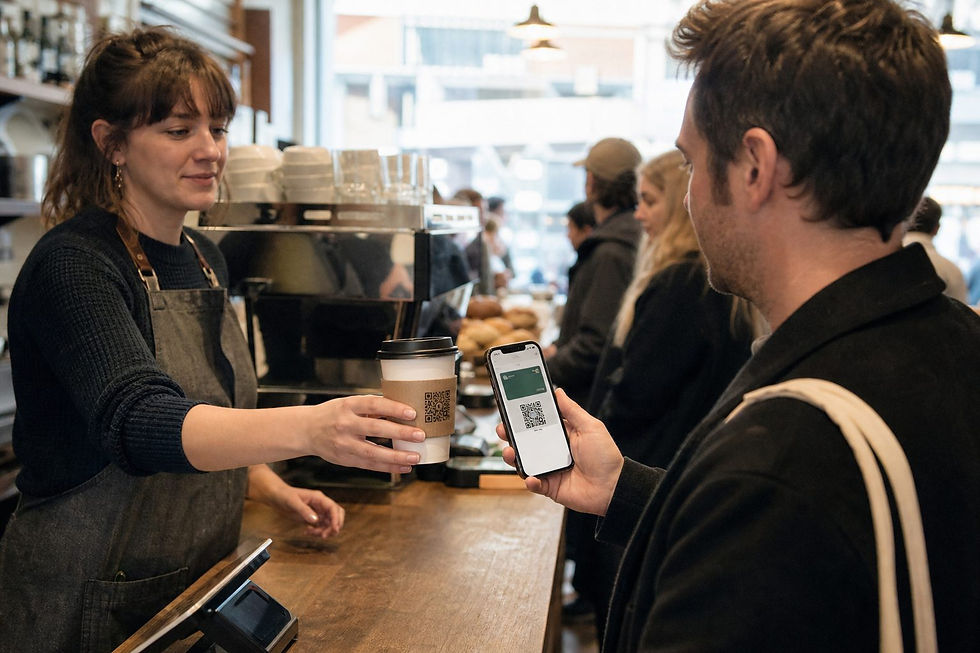
The redemption should work from a glance. The customer opens their wallet pass, shows the barista the coupon or updated stamp count, and the barista marks it redeemed or simply acts on what they see, no scanner, no till integration, no separate login required. meed's AI-powered receipt scanning (Scan by meed) can also award stamps and spend-based rewards automatically by reading a receipt after purchase, which removes the need for POS integration entirely on the earning side, while coupon redemption itself stays a simple visual check at the counter. A cafe running a stamp card and a birthday coupon through a wallet-native system isn't paying for hardware, and isn't training staff on a new till workflow. That's a meaningful difference for a business running on one or two staff during a morning rush.
Frequently Asked Questions
I want to offer birthday discounts to loyal coffee shop customers, how do I do that? Collect birth month only at sign-up, set a simple no-strings reward such as a free drink or bake, and deliver it through a digital wallet pass so it appears automatically in the birthday month without you having to track dates manually.
Can I offer birthday rewards and coupons through a digital cafe loyalty programme? Yes. A digital loyalty programme built on Apple Wallet and Google Wallet passes can trigger a birthday coupon automatically based on the birth month stored at sign-up, and can also carry other coupon types like double-stamp windows or referral coupons on the same pass.
What are good digital coupon ideas for a small independent coffee shop? A timed double stamp during quiet hours, a friends' referral coupon for first-time visitors, and a new-menu taster coupon tied to a launch date all work well because each targets a specific customer behaviour rather than offering a blanket discount.
What customer data do I need for birthday rewards? Birth month only. A full date of birth isn't necessary to trigger a once-a-year reward, and collecting less than you need creates unnecessary risk under UK GDPR's data minimisation principle.
Do digital coupons need to meet any legal requirements in the UK? Yes. Promotional coupons and offers are governed by the Consumer Protection from Unfair Trading Regulations 2008 and the UK CAP Code, which requires that significant conditions, such as start and end dates, eligibility, and restrictions, are displayed clearly and upfront in the initial marketing.
Do customers need to download an app to receive a birthday coupon? No. A coupon delivered to Apple Wallet or Google Wallet sits on a pass the customer already has the infrastructure for, since most UK adults are already registered for at least one mobile wallet service. No separate app download is required.
About meed
meed is a digital loyalty platform built for independent businesses, including coffee shops, that need a loyalty and coupon system without a POS integration, an app build, or a dedicated marketing team. Customers enrol through a QR code, NFC tap, or link, and their loyalty card, stamps, and coupons appear directly in Apple Wallet or Google Wallet. The Free plan covers core features, digital cards, QR enrolment, wallet integration, and nearby notifications, at no cost, while meed Pro adds custom push notifications and advanced member, location, and campaign analytics for cafes ready to run more targeted birthday and coupon campaigns.
Running a coffee shop and wanting birthday rewards and coupons that your customers already have access to, without adding a new app or till system, meed delivers that at https://www.meedloyalty.com/.


Comments