
What Loyalty Platforms Look Like After 12 Months: Setup Promises vs. Operational Reality for Independent Businesses

Updated: Jul 28
Most loyalty platforms are sold on setup. Quick. Simple. Five minutes. What they don't tell you is what month three looks like when the novelty is gone, staff are skipping the check-in step, and your so-called loyalty data is a spreadsheet you've never opened. The gap between the demo and the daily reality is where most independent businesses quietly give up. This article maps that gap honestly, covering what a loyalty program actually demands after launch, where platforms tend to fall short, and what separates tools that survive from tools that get ignored.
TL;DR
Setup is not the hard part. Sustained operation is where most loyalty programs fail for independent businesses.
The biggest operational pressures are staff consistency, member engagement drop-off, and data you can't act on.
Platforms built for large chains create friction that small businesses can't absorb.
Wallet-native loyalty (Apple Wallet loyalty card, Google Wallet loyalty program) removes the biggest single drop-off point: the app download.
Choosing the right tier matters. Not every platform feature is available on every plan, and the wrong choice shows up at month six.
About the author: meed is a digital loyalty platform built exclusively for independent and small businesses. With deployments across cafes, salons, fitness studios, retail, and events, meed's operational perspective on loyalty programs comes from watching real businesses run these programs day-to-day, not from theory.
Why Do Loyalty Programs Fail After the First Few Months?
Implementation and adoption are two different problems, and most platforms only solve the first one [1]. Setting up a loyalty card takes an afternoon. Getting your team to prompt every customer, every shift, for twelve consecutive months is a different ask entirely.
The failure pattern is consistent:
Week one: owner is enthusiastic, staff follow along
Month two: the prompt starts getting skipped when it's busy
Month four: enrollment has stalled, active members are a small slice of actual customers
Month six: the dashboard goes unchecked because there's nothing useful to act on
Month twelve: the program exists in name only
This isn't a discipline problem. Programs with high friction at the point of check-in, or platforms that require a customer to download an app, lose momentum fast [3]. According to loyalty strategy research, complexity at enrollment is one of the primary reasons members disengage before they ever earn a reward [6].
What Does "Setup in Minutes" Actually Mean Operationally?
Building on the failure pattern above, the harder question is what "quick setup" leaves unfinished. Every platform promises fast launch. What they're describing is card creation, not program readiness [2].
True operational readiness for an independent business means:
Staff know how to prompt customers without it feeling like a sales pitch
The check-in method works when it's busy (no device to find, no code to find on a phone)
Customers can enroll in under 30 seconds without downloading anything
Rewards are visible and understandable without explanation
You can see who's engaging and who isn't, and do something about it
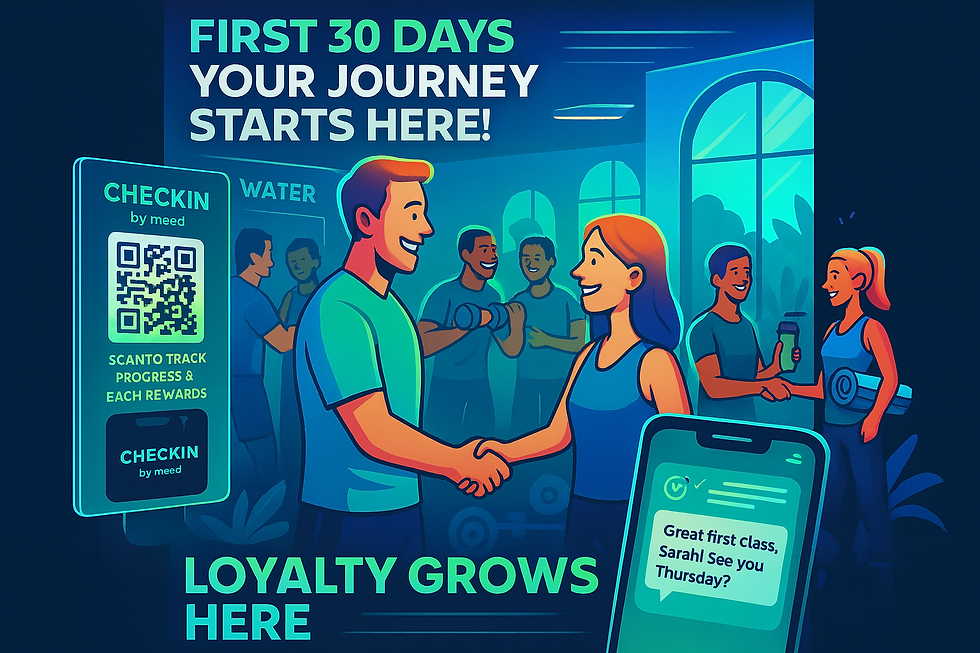
Platforms that use NFC tap-in or QR codes remove the slowest part of the process. The customer doesn't navigate an app. The staff member doesn't explain anything. The interaction takes seconds [7]. meed's NFC check-in (Checkin by meed) and QR enrollment were built specifically for this scenario: a busy counter, a line behind the customer, no time for a three-step process.
How Does the Absence of an App Affect Retention Rates?
A related but distinct question is whether wallet-native delivery changes long-term member retention, not just enrollment. The answer is yes, and the mechanism is visibility.
An Apple Wallet loyalty card or Google Wallet loyalty program card sits on the customer's phone permanently. No login. No password. No "I forgot which app that was." It surfaces via location-triggered notifications when the customer is near the business. That passive visibility maintains the habit without requiring the customer to actively remember they're a member [3].
Compare that to a standalone app: it gets downloaded, used twice, pushed to page four, and eventually deleted. The business has no way back to that customer unless they re-download.
Wallet-native isn't a feature preference. A retention architecture decision.
What Loyalty Platform Features Actually Matter at Month 12?
Stepping back from the enrollment mechanics, a separate concern is what you actually need from a platform once the initial excitement has passed. Here's what independent business owners consistently report needing at the twelve-month mark [4]:
Operational Need | Why It Matters at Month 12 | Platform Requirement |
Re-engagement messaging | Members go quiet. You need a way to reach them before they lapse. | Custom notifications (Pro-tier feature on meed) |
Enrollment data | You need to know if the program is actually growing. | Analytics dashboard |
Reward redemption visibility | Are members reaching the reward? If not, the program isn't working. | Transaction and redemption tracking |
Location-based nudges | Passive prompts when customers are nearby drive repeat visits without effort. | Nearby notifications (available on both meed plans) |
POS-independent earning | Staff turnover and POS changes shouldn't break the program. | AI receipt scanning or NFC tap-in |
The re-engagement use case is worth naming precisely. If you want to send a custom message to members who haven't visited in 30 days, that requires meed Pro. Nearby notifications are available on both plans, but business-initiated custom push messages are a Pro feature. That distinction matters when you're evaluating whether the free tier fits your twelve-month goals [8].
How Does meed Compare to Other Wallet-Native Loyalty Platforms?
The market for wallet-native loyalty has grown. Platforms like Loopy Loyalty, Highlight Cards, Stamp Me, and Boomerangme all offer Apple Wallet and Google Wallet delivery in different configurations. Choosing between them comes down to three practical questions: what does enrollment cost your customer, what does the platform cost you at scale, and what do you get without needing a developer.
Platform | Starting Price | AI Receipt Scanning | NFC Tap-In | Member Cap on Entry Plan |
meed (Free) | Free | Yes | Yes | 50 members |
meed (Pro) | US$59/month | Yes | Yes | Unlimited |
Loopy Loyalty (Starter) | US$25/month | Not listed | Not listed | Unlimited |
Highlight Cards (Start) | US$25/month | Not listed | Staff scanner app only | Unlimited |
Boomerangme | 14-day trial; pricing varies | Not listed | Not listed | Not listed |
meed's specific differentiators are AI receipt scanning (no POS integration needed, Scan by meed reads the receipt directly) and NFC tap-in for instant check-in at the counter. Highlight Cards uses a staff-side scanner app for check-ins rather than NFC tap. Loopy Loyalty is priced lower at one location but doesn't publish AI receipt scanning as a feature. At two locations, meed Pro at US$59/month is cheaper than Loopy's Growth tier at US$69/month.
What Should an Independent Business Actually Expect From Year One?
Realistic benchmarks matter more than marketing claims. Research on loyalty program performance consistently finds that members spend more and visit more frequently than non-members [5]. Program-level lift in purchase frequency tends to fall in the range of 30 to 60%, and small improvements in retention have an outsized revenue effect [3].
What those numbers don't tell you is that they assume an active program, consistent staff prompting, and members who stay enrolled long enough to reach a reward. That last point is the one most businesses miss. A member who enrolls but never earns a reward is not a loyalty member. They're an abandoned record.
Year one success looks like:
A growing enrolled member base, not just an initial spike
Reward redemptions happening regularly, meaning members reach the reward
Staff treating the prompt as routine, not optional
At least one re-engagement action taken when member activity drops (requires Pro on meed)
Frequently Asked Questions
Do customers need to download an app to use meed?
No. Loyalty cards are stored directly in Apple Wallet or Google Wallet. Customers enroll via QR code or link. Nothing to download.
What's the difference between meed's Free and Pro plans?
The Free plan supports up to 50 members and includes core features: digital loyalty cards, QR enrollment, wallet integration, and nearby notifications. Pro (US$59/month) adds unlimited members, custom notifications (business-initiated push messages), and advanced analytics. If you want to message lapsed members directly, you need Pro.
Does meed require POS integration?
No. AI receipt scanning (Scan by meed) reads the customer's receipt to award points. No POS connection needed.
What are nearby notifications and who gets them?
Nearby notifications are location-triggered alerts delivered via Apple Wallet or Google Wallet when a customer is near your business. They're available on both the Free and Pro plans. Custom notifications (business-initiated messages sent at any time) are Pro only.
At what point should an independent business upgrade to meed Pro?
When you want to send targeted messages to specific member segments, or when you need analytics beyond basic enrollment data. If your program is growing and you have members who've gone quiet, Pro's custom notifications are the tool for that.
How does wallet-native loyalty compare to a standalone loyalty app?
Wallet-native loyalty removes the download barrier entirely. Cards sit passively on the customer's phone and surface via location. Standalone apps require download, login, and active use to stay relevant. For independent businesses, wallet-native reduces drop-off at every stage of the customer experience [3].
Is meed suitable for businesses with more than one location?
Yes. meed Pro includes multi-location management with the first two locations covered. Additional locations are US$39/month each. There's also a multi-location dashboard for franchise and multi-site operators.
About meed
meed is a digital loyalty platform built for independent and small businesses. No app required for customers, no POS integration required for setup. Loyalty cards are delivered natively to Apple Wallet and Google Wallet, accessible via NFC tap-in, QR code, receipt scanning, or link. meed's free plan covers core loyalty features for businesses starting out; the Pro plan at US$59/month adds unlimited members, custom notifications, and advanced analytics for businesses ready to run a more active program. Deployed across cafes, salons, gyms, retailers, events, and more, meed is built for the business owner who needs it to work during a shift, not after it.
If your current loyalty setup isn't surviving daily operation, or you haven't started yet because the last tool you tried didn't stick, meed is worth an honest look.
References
Loyalty program implementation: a step-by-step guide - Open Loyalty (www.openloyalty.io)
Omnivy Blog | A Complete Guide to Loyalty Program Implementation (omnivy.io)
Loyalty programs: How they work, examples, and tips (www.zendesk.com)
Company Capability Guide: Are You Ready for Loyalty Programs? (www.pangolinmarketing.com)
Customer Loyalty Program: The Complete Guide for 2026 | EmberTribe (embertribe.com)
37 Loyalty Program Best Practices & Strategies | Antavo (antavo.com)
How to implement a customer loyalty program for retail in 2026 (voyado.com)
Loyalty software buyer's guide: types, trends, and how to choose the best platform (www.voucherify.io)

Comments