
How to Set Up a Takeaway VIP Loyalty Club on Meed: Step-by-Step Setup Guide

Updated: Aug 9
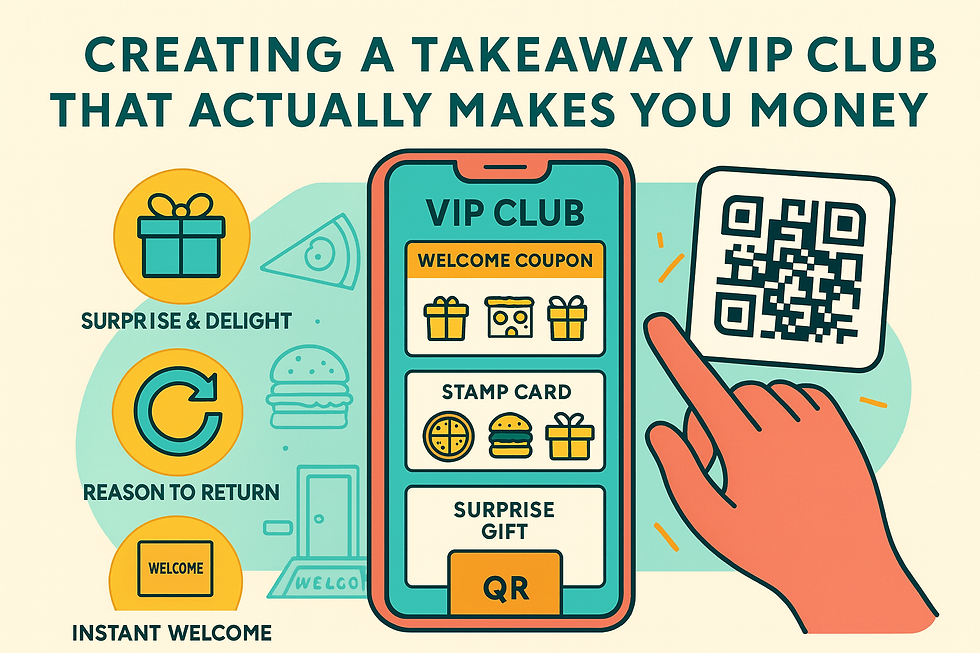
A takeaway VIP loyalty club on meed is built in four steps: choose a digital stamp card as your program type, set a stamp threshold matched to your customers' average weekly spend, configure a members-only offer to drive a specific behaviour, and use your dashboard to confirm whether the program is generating new revenue rather than just discounting orders people would have placed anyway. The entire setup takes under five minutes. No POS integration required.
TL;DR
Digital stamp cards are the right program type for most takeaways. Simple, visible progress, no friction.
Set your stamp threshold so a typical customer hits their reward in 3 to 4 weeks. Too long and they disengage.
A members-only day offer (e.g. a Tuesday special) drives incremental visits on your quietest shift.
Customers save their loyalty card to Apple Wallet or Google Wallet. No app download, no new account to forget.
The meed free plan covers up to 50 members with core features. meed Pro ($59/month) adds custom notifications (business-initiated push messages to members), advanced analytics, and unlimited members.
About the Author: meed is a digital loyalty platform built specifically for independent businesses. The platform has designed and deployed loyalty programs across takeaways, restaurants, cafes, and food vendors internationally, giving meed direct, operational insight into what makes a food-and-beverage loyalty program generate revenue rather than just participation.
Why do takeaway loyalty programs fail before they start?
Most takeaway loyalty programs fail at the design stage, not the execution stage. The program gets built around what feels generous rather than what drives a behaviour change.
The numbers are clear on why this matters. Currently, 57% of restaurants offer loyalty programs and 52% of consumers participate in them. Loyalty members visit 22% more frequently than non-members and spend 12% to 18% more per visit. The upside is real. The downside: a poorly calibrated program erodes margin without changing customer behaviour at all.
The two most common failure modes:
Threshold too high. A "buy 20 get 1 free" card means a customer spending £10 per visit needs 20 visits to see any reward. That is months. They stop caring by week three.
Reward too generic. A free item the customer was never going to order anyway is not a reward. It is a coupon for something unwanted.
A well-built VIP club fixes both problems before the first customer joins [neoday.com].
Which program type should a takeaway choose?
Before configuring anything, you need to pick the right structure. The wrong choice means rebuilding later [openloyalty.io].
Program Type | How It Works | Best For Takeaways?
|
Digital stamp card | Customer earns one stamp per visit or qualifying spend. Reaches threshold, redeems reward. | Yes. Simple, fast, visible progress. |
Points-based | Customer earns points proportional to spend. Redeems at a set rate. | Rarely. Requires more mental load. Better for retail. |
Tiered / VIP tiers | Customer advances through Bronze, Silver, Gold levels with escalating rewards. | Occasionally. Works if you have a large, loyal base already. |
Punch card (paper) | Physical card stamped at point of purchase. | No. Gets lost, left at home, forgotten. No data. |
The recommendation for most takeaways: digital stamp card.
The reason is mechanical, not aesthetic. A stamp card shows progress visually. Customers can see they are three stamps from a reward. That visibility drives return visits in a way that an abstract points balance does not [datacandy.com]. It is the difference between a progress bar and a number on a screen: one creates urgency, one gets ignored.
How do you set the right stamp threshold for a takeaway?
Building on the program type decision, the threshold is the single most important calibration in your setup. Get it wrong and the program either costs you margin unnecessarily or fails to motivate anyone.
The formula: Target reward frequency divided by average visit frequency equals your stamp count.
Worked example for a typical takeaway customer spending £40 to £60 per week:
Average order value: £14
Average visit frequency: once per week
Target: customer earns a reward roughly once per month
Stamp threshold: 4 stamps (one per visit, reward after 4 weeks)
At 4 stamps, the reward feels achievable. The customer can mentally track it. And you are rewarding someone who has already spent approximately £56 with you, so a free side or a discounted item sits inside a defensible margin.
If your customer visits twice a week, drop to 6 stamps for a similar monthly cadence. If they visit fortnightly, 2 stamps is enough to keep them engaged [squareup.com].
What to offer as the reward: Pick something with low cost-of-goods and high perceived value. A free portion of chips, a free soft drink, or a free starter works better than a percentage discount because the customer experiences it as a gift rather than a price adjustment. Percentage discounts train customers to expect cheaper prices. Free items do not.
How do you set up a takeaway VIP club on meed, step by step?
With the structure decided, here is the actual setup sequence on meed. The free plan covers up to 50 members and includes all core features: digital stamp cards, QR code enrollment, Apple Wallet and Google Wallet integration, and nearby notifications [openloyalty.io].
Step 1: Create your meed account
Go to meedloyalty.com and register your business. You will be taken into the meed Business Portal, a web dashboard where everything is configured. No software to install.
Step 2: Build your digital stamp card
Select "Stamp Card" as your program type. Upload your logo and set your brand colours. Name the card something specific to your business rather than a generic "Loyalty Card." A name like "Friday's VIP Club" or "[Your Name]'s Regulars" creates identity. Set your stamp count (based on the threshold calculation above). Set your reward description clearly: "4 stamps earns you a free portion of chips." Specific beats vague every time [neoday.com].
Step 3: Configure your welcome coupon
Within meed, you can attach a digital coupon to new member enrollment. Set a welcome offer that delivers immediate value: 10% off the first order, or a free drink on the first visit. This converts a first-time customer into a club member at the moment of highest motivation. The coupon is delivered automatically when they join. You do not need to remember to hand anything over.
Step 4: Set up your QR code enrollment
meed generates a QR code for your program. Print it. Put it on your counter, on your packaging, on your receipts. When a customer scans it with their phone camera, they join the club and add their loyalty card to Apple Wallet or Google Wallet in under 30 seconds. No app download. No account creation [datacandy.com].
Step 5: Configure your members-only Tuesday offer
This is the step most takeaways skip and the one that drives incremental revenue most directly. In your meed portal, create a time-limited coupon valid only on Tuesdays (or whichever is your quietest shift). Offer something exclusive to members: "Members get a free upgrade to large on Tuesdays." This gives your club members a specific reason to choose Tuesday instead of Friday when both work for them. You are shifting demand to a shift that otherwise sits below capacity. That is new revenue, not discounted existing revenue.
Note: if you want to send a custom push notification to members reminding them about Tuesday's offer, that requires meed Pro. The free plan supports nearby notifications (wallet-triggered, location-based) but not business-initiated custom messages.
Step 6: Choose your check-in method
meed supports three ways for customers to log a visit and earn a stamp:
AI receipt scanning (Scan by meed): Customer photographs their receipt. meed reads it automatically and awards the stamp. No POS connection needed.
NFC tap-in (Checkin by meed): Customer taps their phone on an NFC point at your counter. Instant stamp, no staff involvement beyond placing the device.
QR code scan: Staff scan the customer's wallet card QR code, or the customer scans a QR code at your till point.
For a busy takeaway counter, NFC tap or receipt scanning tends to be fastest. No queue slowdown.
How does Apple Wallet and Google Wallet loyalty actually work for customers?
A related but distinct question from setup is what the customer experience actually looks like, because it determines whether they use the card or forget it.
When a customer joins via your QR code, they are prompted to add their loyalty card to Apple Wallet or Google Wallet. The card sits on their device, exactly like a boarding pass or a bank card. They do not need to open an app. They do not need to remember a login.
On the technical side: Apple Wallet uses the Apple VAS (Value Added Services) NFC protocol, supported on iPhone 6 and later and Apple Watch devices. Google Wallet uses the Google Smart Tap protocol, requiring Android 9.0 or higher with NFC and HCE (Host Card Emulation) support. Both require certified NFC readers that support their respective protocols.
Over 60% of the global population uses digital wallets, and US adoption exceeds 50%. Virtually all modern iOS and Android users have Apple Wallet or Google Wallet available natively on their device. Your customers already have the infrastructure. You are just giving them a reason to use it with you.
The practical outcome: the card is on the phone the customer already carries. When they walk near your takeaway, wallet-based nearby notifications can surface the card on their lock screen. Passive, automatic, requires nothing from your staff.
How do you tell if your VIP club is generating real revenue or just discounting existing orders?
This is the question that separates a loyalty program that makes money from one that just makes customers feel appreciated while quietly reducing your margin.
The core distinction: incremental revenue is an order that would not have happened without the program. A discounted existing order is one the customer would have placed regardless, at full price.
Three signals that indicate incremental revenue:
Visit frequency increases after joining. If a member visited once per fortnight before joining and now visits weekly, the program is generating additional visits. That is new money.
Tuesday (or your quiet-day) orders from members increase. If your members-only Tuesday offer drives orders specifically on Tuesday that did not exist before, those are incremental. Track Tuesday order volume before and after launch.
Members spend more per visit than non-members. Market data shows loyalty members spend 12% to 18% more per visit. If your members are at or above that range, the program is working. If they are below, your reward structure may need recalibrating.
Three signals that suggest you are discounting existing orders:
Member visit frequency is identical to pre-enrollment frequency.
The only uplift you can identify is coupon redemption, with no change in visit cadence.
Members redeem rewards on orders they would have placed at full price, with no evidence of an additional visit being triggered.
On meed Pro, the advanced analytics dashboard shows member performance, visit patterns, and campaign results by location. This is where you move from guessing to knowing. If your member base is still small (under 50 members), the free plan covers you. Once you scale past that and want to track campaign performance by cohort or push targeted re-engagement to members who have lapsed, that is the point to move to Pro at $59/month [neoday.com].
What data compliance requirements apply to a takeaway loyalty program?
Stepping back from the operational detail, a separate concern is legal compliance. It is not complicated, but it is non-negotiable.
In the EU and UK, digital loyalty programs must comply with GDPR and UK GDPR. The requirements:
Explicit, affirmative consent before collecting member data.
Data minimization: collect only what is needed to run the program.
Members must be able to access or delete their data on request.
In the US, state-level laws apply. Under the California Consumer Privacy Act (CCPA), loyalty programs are classified as financial incentives, requiring clear disclosures and opt-out options before a customer hands over personal data in exchange for rewards.
meed's enrollment flow is designed with consent built in. Members opt in explicitly when they join. That said, you are responsible for ensuring your program's terms are visible and your privacy policy is current.
Frequently Asked Questions
Do my customers need to download an app to join the VIP club?
No. Customers join by scanning a QR code with their phone camera and add the loyalty card directly to Apple Wallet or Google Wallet. No app download, no account creation, no password to forget.
How many stamps should I set for a typical takeaway loyalty card?
For a customer spending £40 to £60 per week with an average order value around £14, a 4-stamp threshold gives a roughly monthly reward cadence. Adjust based on your actual visit frequency. The goal is a reward that feels achievable within 3 to 4 weeks [squareup.com].
What is the difference between the meed free plan and meed Pro for a takeaway?
The free plan covers up to 50 members and includes digital stamp cards, QR enrollment, Apple Wallet and Google Wallet integration, and nearby notifications. meed Pro ($59/month) adds custom notifications (business-initiated push messages to members), advanced analytics, and unlimited members. For most takeaways launching their first program, the free plan is the right starting point.
Can I send a message to members who have not ordered in two weeks?
Yes, but this requires meed Pro. Custom notifications (business-initiated push messages) are a Pro-only feature. The free plan does not include them. If re-engagement messaging is a priority from launch, factor Pro into your decision from day one.
What is the best reward for a takeaway loyalty program?
Free items with low cost-of-goods and high perceived value: a free side, a free drink, a free upgrade. Avoid percentage discounts as the primary reward. They reduce perceived price rather than create a feeling of being recognised [datacandy.com].
How does a members-only Tuesday offer drive incremental revenue?
It shifts demand to a low-capacity shift rather than competing with your busiest periods. A member who would have ordered on Friday regardless might choose Tuesday to use their member offer. That Tuesday order is additional revenue on a shift that was otherwise quiet. The key is tracking Tuesday volume before and after launch to confirm the shift.
Does meed work if I do not have a POS system?
Yes. meed's AI receipt scanning (Scan by meed) reads a customer's paper or digital receipt without any integration with your till. Customers photograph their receipt, meed reads it, and the stamp is awarded. No POS connection needed [openloyalty.io].
About meed
meed is a digital loyalty platform built for independent and small-to-medium businesses. It delivers app-free loyalty programs stored in Apple Wallet and Google Wallet, using AI-powered receipt scanning, NFC tap-in, and QR code enrollment to make earning and redeeming rewards frictionless. meed serves takeaways, restaurants, cafes, salons, gyms, and retail businesses internationally, with a free plan that covers all core features and a Pro plan adding custom notifications and advanced analytics. Setup takes under five minutes and requires no POS integration, no specialist hardware, and no technical background.
Your takeaway VIP club takes less than five minutes to build.
Start free. No POS integration. No app for your customers to download.
References
Loyalty program implementation: a step-by-step guide - Open Loyalty (openloyalty.io)
How to Start a Loyalty Program for Your Restaurant (Step-by-Step Guide) (datacandy.com)
How To Create a Restaurant Loyalty Program | Square (squareup.com)
How to Start a Restaurant Loyalty Program: Step-by-Step Guide (neoday.com)



Comments